It is the beginning of June. For thousands of high school students, university students, and professionals undergoing certification, the coming days represent the culmination of months of work. The big exam rush is here.
The scene is classic, almost universal: you went to bed at midnight, reviewing your notes one last time. You know your subject. Yet, the next morning, sitting in front of your exam paper at 8:02, it’s a blank page. Nothing. Your hands become sweaty, the lines blur, and your memory seems to have been completely erased overnight.
It’s not a lack of work. Nor is it an inevitability linked to "nerves."
Neuroscience has just proven that this memory blank is the direct consequence of the "Forced Awakening Syndrome". In short: the way you got up this morning literally locked access to your hippocampus, the brain area that stores your knowledge.
Hippocampus Inhibition: When Noise Erases Data
During the last phase of your night (REM sleep), your brain sorts, consolidates, and engraves the information learned the day before. This is when memories move from short-term to long-term memory.
When your smartphone or traditional alarm clock starts screaming on your nightstand, your nervous system undergoes an acoustic shock. To pull you out of sleep, the amygdala (the fear center) orders a massive release of survival cortisol and noradrenaline.
The scientific fact: A sudden and artificial cortisol spike upon waking contracts cerebral blood vessels and saturates hippocampus receptors. The brain instantly switches to "imminent threat" mode. Its absolute priority is no longer to remember the date of the French Revolution or a complex theorem, but to flee danger. You have just blocked access to your own revision notes.
Nocturnal Waves: The Background Noise That Prevents Engraving
It gets worse. For this memory consolidation process to work 100%, your brain needs completely pure deep slow-wave sleep.
Leaving your smartphone on, charging, or less than a meter from your head during June nights (when heat already disrupts cycles) is a cognitive nonsense. Micro radiofrequency emissions (Wi-Fi, 4G, Bluetooth) act as invisible electromagnetic background noise. Your brain doesn’t descend deep enough into Delta frequencies. You sleep, but you don’t memorize.
The "Sharp Mind" Protocol for Exam Mornings
To face your exam paper or strategic meeting with all your cognitive faculties intact in June, you must apply a principle of sensory purity. Top performers never use their smartphone as an alarm during rush periods.
The strategy rests on three simple physiological pillars:
-
Exile the disruptor: The smartphone spends the night in another room, turned off or offline. Your sleep space becomes a white zone, conducive to neuroplasticity.
-
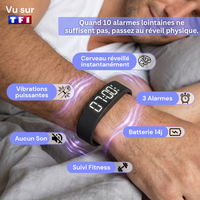
Wake up by tactile conduction: Instead of assaulting your eardrums and saturating your hormones, you use haptic stimulation. A targeted vibration on the wrist stimulates skin receptors in isolation. The signal goes directly to the brainstem, triggering a calm, smooth, and gradual awakening through Alpha waves.
-
Immediate access to data: Without an aggressive cortisol spike, your prefrontal cortex lights up gently. Your memory is fluid, available, intact.
The Tool Defines Your Success
The effort you put into your revision or projects deserves to be honored by an alarm clock that respects your neurons. Treating your brain like a precision machine means giving it tools that match. An alarm clock that does only one thing, but does it with absolute biological perfection: waking you up in silence and clarity.
Will you arrive at your exam in survival mode or mastery mode?
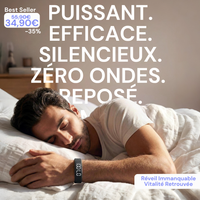
Don’t let a shrill ring ruin weeks of effort. Discover PulseOn Rise, the vibrating alarm bracelet designed for the academic and professional elite. 100% autonomous, 100% wave-free. Free your memory, own your morning.
So you never miss your alarms again
Discover the vibrating alarm bracelet that wakes you up and gets you out of bed for sure!